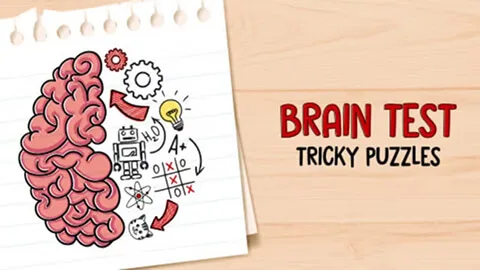
Brain Test: Tricky Puzzles
🧠 What Is Brain Test: Tricky Puzzles?
Brain Test: Tricky Puzzles is a free collection of short brain teasers designed to challenge assumptions rather than test memorized facts. A prompt may look like a normal calculation, visual question, or multiple-choice problem, yet the solution can require moving a word, combining pictures, uncovering a hidden object, or touching something that does not look like a button. The whole screen can be part of the puzzle.
Each level is brief, but the interaction changes frequently. A method learned in one question may be deliberately contradicted by the next, encouraging flexible thinking instead of repetition. Hebigame uses its own g.hebi.gg resource, so the game launches free in a browser and also works well as a group activity where players propose different theories.
🎮 Controls and How to Read a Question
Use clicks and dragging on desktop. On mobile, try tapping, holding, swiping, and using more than one finger when appropriate. Inspect the prompt, pictures, numbers, screen edges, and apparently empty areas before choosing an answer. Text and decorative objects may also be interactive.
Read ambiguous words in more than one way. The largest number might mean the greatest value or the physically largest text. An object you are asked to find may be behind another image. A real-world answer can be wrong when the puzzle is asking about what is literally visible on the screen.
🔍 Common Trick Patterns
Many levels use movable prompt text, hidden objects, unusual scale, or two items that must be combined. Others require moving something off screen, holding one object while touching another, or noticing that an equation counts pictures rather than conventional numbers.
If repeated taps do nothing, change the type of interaction instead of tapping faster. Test a drag, long press, combination, or two-finger action. Keep a hypothesis: what is missing, what looks inconsistent, or which assumption is the question encouraging you to make? Purposeful experiments teach more than random touching.
🏆 What to Do When You Are Stuck
First reread the wording and look for a second interpretation. Next, test whether every object can move. Compare size, color, position, count, and the relationship between the prompt and the picture. Only then consider device-style actions such as simultaneous touch or moving beyond the visible center.
Hints are useful when they reveal the category of trick, but do not stop at the answer. Identify the clue you missed and explain why the initial interpretation failed. Replaying a hinted level later confirms whether you learned the reasoning or only remembered one tap location.
✨ Why It Works as a Brain Game
The game exercises observation, creative problem solving, and the ability to abandon an unproductive assumption. Comic outcomes make failure feel light, while later levels can require several interactions in a specific order. This balance makes it approachable for families and still interesting for players who like lateral-thinking puzzles.
Choose Brain Test if you want free brain games, trick questions, or a puzzle that is fun to discuss with friends. Before searching for an answer, inspect the wording, images, boundaries, and interaction type one more time; the missing step is often hiding in plain sight.
🔍 The Most Valuable Step Comes After the Answer
Once a level is solved, describe the assumption that made it difficult. Perhaps you treated text as fixed, confused numerical value with visual size, or ignored the edge of the screen. Naming that mistake builds a reusable mental tool.
In a group, divide attention: one person studies language, another inspects images, and another proposes unusual interactions. Different perspectives reduce tunnel vision and turn each surprising solution into a shared reasoning exercise.