
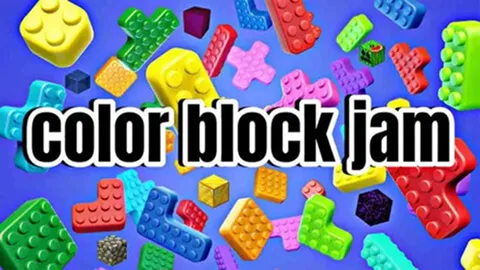
Color Block Jam
🎨 What Is Color Block Jam?
Color Block Jam is a free sliding puzzle about guiding colored blocks into matching doors. A selected block moves in the chosen direction until the board layout, a wall, or another piece stops it. Clearing every block completes the stage, but the nearest route is not always the correct one. Removing one color too early can eliminate a useful stopping wall or close the corridor another block needs.
The basic color matching remains readable as the game introduces fixed obstacles, connected pieces, frozen doors, crates, bombs, and flexible special blocks. Later stages therefore combine route planning with order control. Hebigame uses the g.hebi.gg game resource, so Color Block Jam starts free on desktop and mobile browsers without a separate installation.
🎮 Controls and Stage Objective
On desktop, select a block with the mouse and drag in the intended direction. On mobile, touch and swipe. Before moving, trace the entire path to the stopping point and confirm the matching door. The final position matters because it becomes part of the route for the next color.
The objective is to send every colored block through its corresponding exit. Early levels often allow the closest piece to move first. Complex boards may require moving a distant blocker, using another color as a temporary wall, or opening a route several steps before the target can enter its door.
🧱 Understanding Advanced Obstacles
Fixed blocks reduce the available lanes, while ropes can link the behavior of two pieces. Ice, crates, or locked doors may add a condition that must be solved before normal color routing resumes. Bombs introduce a move limit or other urgency, making a safe but wasteful detour unacceptable.
Use the first level featuring a new mechanic as a controlled experiment. Determine what moves, what remains a wall, what removes the obstacle, and whether a cleared item changes another route. Once the rule is understood, the same mechanic becomes information you can use in future planning instead of an unexpected interruption.
🏆 How to Solve Difficult Levels
Work backward from a door. Identify the final stopping position required by its block, the corridor leading to that position, and every piece currently occupying that corridor. This reverse route turns a crowded board into a sequence of smaller requirements.
Do not assume a block should disappear as soon as it can reach its exit. It may provide the only wall that stops another block in the correct square. Assign each piece a current role: target to clear, obstacle to move, or temporary support to preserve. The role can change after another color exits.
If a sequence fails, locate the move that first closed the route rather than repeating faster swipes. Write the plan mentally in groups of three actions: move red up, clear blue, return red. A sequence you can explain is easier to correct and reproduce than random trial and error.
🧠 What Skills Does It Test?
Color Block Jam develops spatial visualization, reverse planning, and the ability to order dependent tasks. It offers the satisfaction of a clear solution rather than relying on reflexes or random matches. The bright color coding makes each goal easy to identify even when the route becomes complicated.
It is a good choice for fans of sliding puzzles, traffic-jam games, and short brain-training levels. Begin by matching colors and doors, then learn to preserve useful stopping walls, and finally solve bombs and linked obstacles with a complete move sequence.
🔍 A Better Way to Learn From a Solution
After completing a level, identify the one piece that served as the most important temporary wall and the move that opened the final route. Remembering those roles helps you recognize the same structural pattern when colors and obstacle positions change.
For difficult boards, separate planning from execution. Decide the next three moves while the board is still, then perform them carefully. This reduces accidental swipes and makes it obvious which assumption was wrong if the sequence fails.