
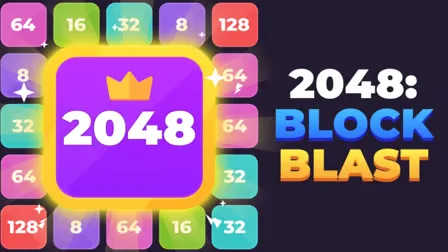
Block Blast 2048
🔢 What Is Block Blast 2048?
Block Blast 2048 is a free number-merging puzzle built around the familiar powers-of-two sequence. Combine matching blocks to turn 2 into 4, 4 into 8, and continue toward larger values while preventing the board from filling. The rule is easier to learn than a long instruction list, and each action can be considered at your own pace, making the game suitable for a quick break or a focused brain-training session.
Merging every available pair immediately is rarely the best long-term plan. If high values become scattered across opposite sides, the board spends too many moves and cells reconnecting them. A stable run assigns one region to the largest number, another to developing small values, and enough open space to assemble the next chain. The game starts free in the browser on Hebigame without an installation.
🎮 How Number Merging Works
Select adjacent blocks that display the same value. They combine into one block worth the next power of two, freeing space and increasing the score. Before tapping, inspect the position where the merged value will remain and ask whether another block of that value is nearby. A merge that leads directly to a second merge is far more useful than an isolated score increase.
The objective is to keep producing larger numbers without allowing unrelated low values to occupy every opening. When several pairs are available, process the one that improves the overall order of the board. A small merge near the main chain may be more valuable than a larger merge that leaves its result stranded.
🧠 Organizing Values and Open Space
Choose an edge or corner as the home of the highest block. Arrange smaller values in a rough descending sequence toward it, so each new result has a natural destination. Building new 2s and 4s on the opposite side keeps unfinished material away from the largest value until it is ready to merge.
Open cells are working space, not wasted space. They allow numbers to approach one another and make room for chain reactions. If the board becomes crowded, prioritize several small consolidations over forcing one headline value. Removing isolated low blocks can recover more practical space than one merge at the top of the sequence.
🏆 Strategy for Larger Numbers
Plan two stages ahead. If two 8s can create a 16, first check whether an existing 16 can receive the result. When possible, prepare 8 + 8 and 16 + 16 in the same region. The resulting chain clears multiple cells and moves the largest value forward with fewer turns.
Do not split equal high values across the board. Their numerical value looks promising, but distance makes them difficult to combine. If a move breaks the descending order around your anchor corner, solve another small pair first or preserve the merge until a better route appears.
After a loss, count the unmatched 2s and 4s. Repeated clutter at low values indicates that new material is being spread too widely. Correct the early organization rather than blaming the final number that had no partner.
🌐 How It Differs From Block Blast
Standard Block Blast asks you to place geometric shapes and clear complete lines. Block Blast 2048 focuses on relationships between values and the route from one merge to the next. Both games reward open space and future planning, but this version replaces shape fitting with numerical order and chain construction.
Choose it if you want a free 2048 game, a relaxed number puzzle, or a brain game that rewards methodical organization. Merge the obvious pairs first, establish a home for the largest value, and then build multi-stage chains that improve both score and board space.
🔍 Practice Reading a Merge Chain
When you find a matching pair, pause and name the value it will create. Then locate the next matching value before making the move. This simple two-step check trains you to see a chain instead of a single merge.
Measure improvement by the number of isolated low blocks, not only the highest tile. A run with fewer stranded 2s and 4s has a healthier structure and is more likely to reach a much larger value later.