
Moving Blocks
Play Moving Blocks Online for Free
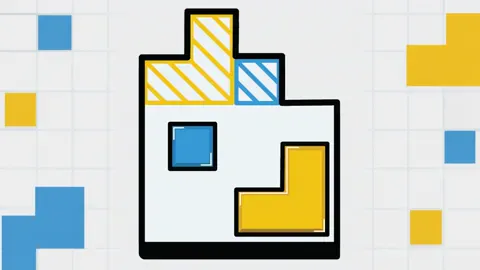
Moving Blocks is a free logic puzzle game with one unusual rule: a directional input moves every available block at the same time. The goal is to place the pieces on their matching striped targets, but you cannot simply select one block and push it into position. Walls, other pieces, shapes, and stopping points become part of the solution. With 129 levels, the game starts as an approachable movement puzzle and gradually becomes a careful exercise in spatial planning.
Think About the Whole Board
A move that helps one block can create a problem for another. Because the pieces travel together, the useful question is not "Where should this block go?" but "Where will every block stop after this direction?" A wall may be an obstacle for one piece and a helpful brake for another. A block can also become the reason a neighboring piece stops in the exact row needed for its target.
This makes the board easier to understand when you plan from the end. Find the striped goals, identify the walls that can stop movement, and work backward to the positions that let all pieces settle. If the board becomes impossible, restart early instead of adding random inputs that make the next state harder to read.
Key Features
- Synchronized movement: All movable blocks travel in the same chosen direction.
- Shape and wall logic: Use stopping points, gaps, and block positions to separate the pieces without directly selecting them.
- 129 levels: Move from short introductory problems to more complex multi-piece layouts.
- Hints and restart: Ask for help or restore the board when a sequence has become unclear.
- Desktop and touch controls: Use Arrow keys or WASD on PC and swipe directions on supported mobile screens.
How to Play Moving Blocks
Inspect the blocks and striped goals before entering a direction. On PC, press the Arrow keys or WASD. On mobile, swipe in the direction you want the pieces to travel. Every movable block responds together, so watch where each one stops against a wall or another piece. Continue until all blocks occupy the correct striped goals. If the current arrangement cannot lead to a solution, use restart; if the game provides a hint, compare it with your own plan before moving again.
Moving Blocks Strategy Tips
- Mark the final direction: Decide how each piece must enter its goal before spending moves on the opening.
- Use walls as brakes: A wall can create a stable stopping point that separates blocks over several inputs.
- Avoid solving one piece too early: A block on its goal may still block the route needed by another piece.
- Record the useful sequence: When a three- or four-move pattern works, remember it as a small unit instead of rebuilding it each time.
Progression and Replay Value
The 129-level structure gives Moving Blocks a clear learning curve. Early problems teach the synchronized rule, middle levels test how walls and shapes interact, and later layouts ask you to plan several moves ahead. A level can be replayed after completion to find a cleaner sequence or to understand why an apparently wasteful move was actually necessary. The satisfaction comes from watching a crowded board settle into a precise final arrangement.
Browser Play on PC and Mobile
Play this free block puzzle in a current browser. Click or tap inside the game frame before using keyboard input or gestures. A larger screen helps when several pieces overlap, while touch players should swipe deliberately so an unintended gesture does not add a move. The loading time and touch response can vary with the device and browser.
Frequently Asked Questions
What is the rule in Moving Blocks? The movable blocks move together in the same direction after each input.
How many levels are there? The game page describes 129 levels.
Can I choose one block by itself? The main rule is synchronized movement, so the solution comes from walls, shapes, and stopping positions rather than direct selection.
What should I do when I am stuck? Use the restart option to return to a clear board, or use the available hint after studying the current positions.